

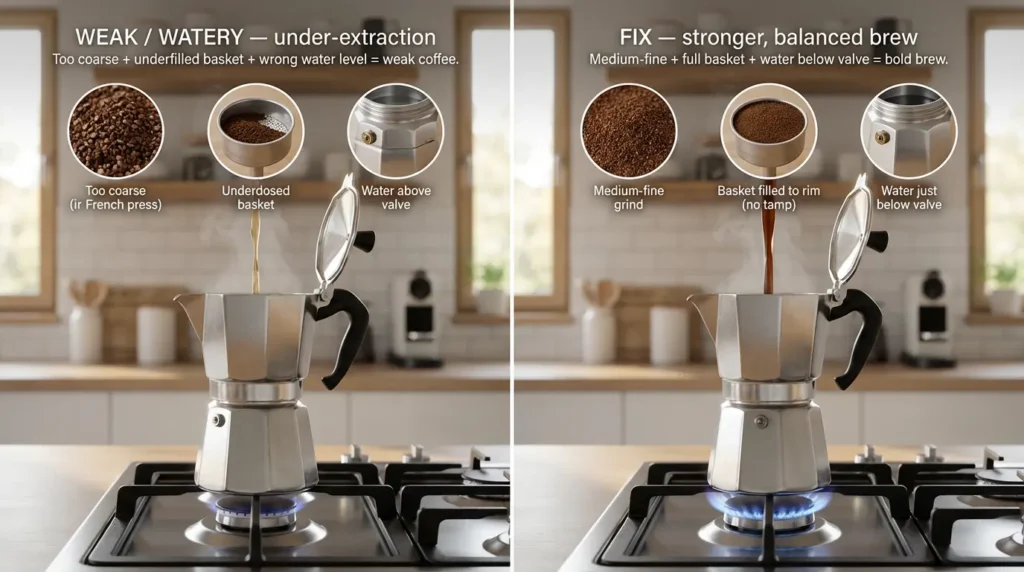
If your coffee maker makes weak, watery coffee, the usual cause is an incorrect coffee-to-water ratio, coffee grounds that are too coarse, or water that does not stay hot long enough. Start by using more fresh coffee, measuring the water, and checking that the machine completes a full brew cycle.
This problem is common in homes across the United States. Many American coffee makers label a “cup” as 5 or 6 fluid ounces, not the 8-ounce cup used on a typical kitchen measuring cup. That difference can quietly add too much water to each pot.
Source: kitchflair.com
What Weak Coffee Really Means
Weak coffee has too little coffee flavor for the amount of water used. It may taste thin, pale, or watery. It can also taste sour if the water did not extract enough flavor from the grounds.
Coffee strength and coffee extraction are related but not identical:
- Strength means how much coffee material is dissolved in the drink.
- Extraction means how much flavor was pulled from the coffee grounds.
- Under-extracted coffee often tastes sour, sharp, or flat.
- Over-diluted coffee tastes weak even when the extraction was acceptable.
A pot can be weak because you used too little coffee. It can also be weak because the grounds are too coarse, the water is not hot enough, or the water passes through the grounds too quickly.
The Specialty Coffee Association commonly uses about 55 grams of coffee per liter of water, with a tolerance of about 10%. That works out to roughly a 1:16 coffee-to-water ratio. Home machines may need small adjustments based on the beans, grind, and personal taste.
The Most Common Causes of Watery Coffee
You are using too little coffee
This is the most common cause. Many people fill a coffee maker to the 10- or 12-cup line but add only a few tablespoons of ground coffee.
As a starting point, use about:
- 10 to 11 grams of coffee for 6 fluid ounces of water
- 20 to 21 grams of coffee for 12 fluid ounces of water
- 55 grams of coffee for 1 liter of water
A tablespoon is not a precise measure because coffee grounds vary in size and density. A kitchen scale gives more consistent results.
The coffee grind is too coarse
Coffee ground too coarsely has less surface area in contact with the water. The water may run through before it removes enough flavor.
For most automatic drip coffee makers, use a medium grind. It should look somewhat like regular sand. Very coarse grounds are better suited to methods such as a French press.
Do not make the grind extremely fine to fix weak coffee. Very fine grounds can slow the flow, clog the filter, and create bitter or muddy coffee.
Your beans are stale
Coffee loses aroma after roasting and becomes less lively after grinding. Stale coffee may produce a thin cup even when you use the right amount.
For the best result:
- Buy coffee in small amounts.
- Store it in an airtight container.
- Keep it away from heat, light, and moisture.
- Grind it just before brewing when possible.
- Avoid storing coffee in the refrigerator, where moisture and odors can affect it.
The roast date is more useful than a vague “best by” date. Coffee freshness varies by roast, package, and storage, so taste is the final test.
The water is not hot enough
Automatic drip coffee generally needs water in the range of about 195°F to 205°F during brewing for good extraction. If the heating system is weak, the coffee may taste thin and sour.
A machine may fail to heat water properly because of:
- Mineral scale
- A failing heating element
- A clogged water path
- A damaged thermostat
- A design issue or age-related failure
Do not open the machine to inspect electrical parts. Unplug it and follow the manufacturer’s cleaning and service instructions.
The brew cycle is too short
Water needs enough contact time with the grounds. If the machine runs too quickly, the coffee can taste weak.
A short brew cycle may result from:
- A grind that is too coarse
- A filter basket that does not sit correctly
- A clogged water tube
- Too few grounds
- A damaged pump or valve
- An incorrect brew setting
If the machine finishes much faster than usual, that change is useful evidence. It may point to a flow problem rather than a recipe problem.
Water is bypassing the coffee grounds
Some brewers allow water to flow around the filter instead of through the bed of coffee. This can happen when:
- The paper filter collapses
- The filter basket is not seated
- The wrong filter size is used
- Grounds block the outlet
- The showerhead spreads water unevenly
The result is a pot with plenty of water but not enough coffee flavor.
The coffee maker’s cup markings mislead you
A “12-cup” coffee maker often holds about 60 fluid ounces if each machine cup is 5 ounces. That is less than eight standard 8-ounce cups, but it is still more water than many people expect.
Read the owner’s manual or measure the reservoir with a kitchen measuring cup. Then match the coffee dose to the actual water volume.

Source: kitchenadvising.com
How to Fix Weak Coffee: A Simple Test
Change one factor at a time. This makes it easier to find the real cause.
1. Measure the water
Fill the reservoir to a known mark. For a clear test, use 24 fluid ounces of water.
Do not rely only on the number of “cups” shown on the machine. Confirm what one machine cup means.
2. Measure the coffee
For 24 fluid ounces of water, start with about 40 to 45 grams of coffee. This follows a ratio near 1:16 and gives you room to adjust.
If you do not have a scale, start with about 7 to 8 level tablespoons of ground coffee. This is only an estimate because spoon volume and coffee density differ.
3. Use a medium grind
Use coffee labeled for automatic drip brewing. If you grind at home, choose a medium setting rather than coarse or espresso-fine.
4. Use fresh, clean water
Tap water is usually fine if it tastes good on its own. If your tap water has a strong chlorine or mineral taste, filtered water may improve the cup.
Do not use distilled water as your normal brewing water. It may produce a flat taste and is not the best choice for many coffee machines.
5. Run a full brew cycle
Do not remove the carafe early unless your machine is designed for mid-brew pouring. Removing it can interrupt the flow or cause the machine to pause.
Let the cycle finish. Stir the brewed coffee gently before serving so the stronger and weaker portions mix.
6. Taste and adjust
Use this order:
- If the coffee tastes watery but not sour, add more coffee.
- If it tastes sour or sharp, use a slightly finer grind or check the water temperature.
- If it tastes bitter, use a slightly coarser grind or reduce the coffee dose.
- If the flavor varies from pot to pot, inspect the filter basket and clean the machine.
The goal is not simply to make coffee darker. Dark color can come from roast level, while good flavor depends on dose, grind, water, and brew time.

Source: homekitchtech.com
A Coffee-to-Water Guide for Automatic Brewers
Use this table as a starting point. It assumes a ratio close to 1:16.
| Water volume | Approximate coffee dose |
|---|---|
| 6 fl oz | 10–11 g |
| 12 fl oz | 20–21 g |
| 20 fl oz | 33–35 g |
| 24 fl oz | 40–45 g |
| 32 fl oz | 53–57 g |
| 1 liter | About 55 g |
These amounts are starting points, not strict rules. A person who likes strong coffee may use more. A light-roast coffee may need a slightly different grind or dose than a dark roast.
If your coffee maker displays 10 cups, do not assume that means 80 fluid ounces. Measure the reservoir or check the manual. A machine cup may be 5 ounces, 5.5 ounces, or 6 ounces.
A useful example: If a machine’s 10-cup mark holds 50 fluid ounces, a 1:16 ratio calls for about 92 grams of coffee. That is far more than the 10 tablespoons many people use, which explains why the result may taste weak.

Source: homekitchtech.com
Clean the Coffee Maker Before Changing the Recipe
Mineral buildup can reduce water flow and heating performance. Oils from old coffee can also leave a stale taste.
Clean the removable parts after each use:
- Empty the grounds.
- Rinse the filter basket.
- Wash the carafe with warm water and dish soap.
- Wipe the showerhead and machine area.
- Leave the lid open so parts can dry.
Descale the machine based on the owner’s manual. Some manuals allow a commercial descaling solution or a vinegar solution. Others recommend a specific product or method.
Do not mix vinegar with bleach or other cleaning chemicals. Never place electrical parts in water.
After descaling, run fresh water through the machine until no cleaning smell remains. A machine may need two or more rinse cycles, depending on its instructions.
A clean machine should show a steady water flow and a normal brew time. If the machine still brews unusually fast or fails to heat, cleaning may not solve the issue.

Source: coffeevoila.com
How to Tell Whether the Machine Has a Problem
Your coffee maker may need service or replacement when the recipe is correct but the brewing behavior is not.
Look for these signs:
- The water is lukewarm after a full cycle.
- The machine takes much longer or much less time than before.
- Water leaks around the filter basket.
- The showerhead delivers water to only one area.
- The pump makes a new rattling or grinding sound.
- The machine shuts off before finishing.
- The coffee stays weak after cleaning and a correct dose.
- The heating plate or cord shows damage.
Unplug the machine before cleaning around the base or checking for visible damage. Do not bypass a fuse, open the housing, or repair live electrical components yourself.
If the machine is under warranty, contact the manufacturer. For an older or inexpensive brewer, replacement may cost less than electrical repair. The deciding factor is not only the price of repair but also the condition of the heating system, carafe, basket, and controls.

Source: kitchflair.com
Common Mistakes That Keep Coffee Weak
Counting spoons instead of weighing coffee
Spoons are convenient but inconsistent. A heaped spoon can hold much more coffee than a level spoon. Different beans also have different densities.
Adding water to finished coffee
Adding hot water makes the drink weaker. It does not fix under-extraction. If the coffee is too weak, brew with more coffee or less water next time.
Using a dark roast because it looks stronger
Dark-roast coffee often looks darker, but color does not prove strength. The amount of coffee dissolved in the cup depends on the recipe and brewing process.
Packing the grounds down
Do not tamp coffee in a standard drip basket. Pressing it can slow water flow and cause uneven extraction.
Using a reusable filter without adjusting the grind
Some permanent filters allow more fines and oils into the cup. They may also change the flow rate. If the coffee tastes thin, compare the reusable filter with a correctly sized paper filter.
Leaving coffee on the warming plate for a long time
Long heating can make coffee taste bitter or burnt, but it will not make the original brew stronger. Use an insulated carafe or brew a fresh batch when possible.

Source: familyguidecentral.com
When Should You Use a Finer Grind or More Coffee?
Use more coffee when the brew is too weak but otherwise tastes balanced. This raises strength without greatly changing the extraction pattern.
Use a finer grind when the coffee tastes weak and sour, especially if the brew cycle is short. A finer grind slows the flow and gives water more access to the coffee.
Make small changes. For example, increase the coffee dose by 10% or move the grinder one setting finer. Large changes can turn a weak cup into a bitter one.
A simple decision guide:
| What you taste | Likely change |
|---|---|
| Watery but smooth | Add more coffee |
| Sour and thin | Grind slightly finer |
| Bitter and harsh | Grind slightly coarser or use less coffee |
| Uneven from pot to pot | Clean and check the filter basket |
| Weak with cool water | Check the heater and descale |
Taste can be affected by roast level, bean type, water, and storage. Use this guide as a starting point rather than a diagnosis.

Source: homekitchtech.com
FAQs About Weak, Watery Coffee
Why is my coffee maker making weak coffee even with enough grounds?
The grind may be too coarse, the water may be too cool, or the water may be bypassing the grounds. Clean the machine, use a medium grind, and check that the filter basket is seated correctly.
Does using more coffee make coffee stronger?
Yes. Using more coffee relative to the water usually increases strength. Increase the dose in small steps so the result does not become too intense or wasteful.
Should I use less water to fix weak coffee?
You can, but measuring more coffee is often easier. If you reduce water, keep the change small and remember that the machine’s cup markings may not equal standard 8-ounce cups.
Can vinegar fix a coffee maker that makes weak coffee?
Vinegar may remove some mineral buildup, but use it only if the manufacturer permits it. Follow the manual, rinse the machine well, and never mix vinegar with bleach or other cleaners.
Is weak coffee a sign that my coffee maker is broken?
Not always. Recipe, grind, stale beans, and incorrect cup measurements are more common causes. Suspect a machine fault if the water is cool, the brew time has changed, flow is uneven, or cleaning does not help.
Final Takeaway
The fastest fix for weak, watery coffee is to measure both water and coffee, use a medium grind, and start near a 1:16 ratio. Then clean and descale the brewer if the flavor or brew time still seems wrong.
If the machine produces cool water, an unusually short cycle, leaks, or uneven flow, stop changing the recipe and inspect the brewer according to its manual. Unplug it before any cleaning or service work.